Modern Foreign Languages at Gade Valley Primary School
Modern Foreign Language Subject Leader: Ms Reed
Curriculum Aims
At Gade Valley Primary School, we believe that enabling pupils to develop a love for language provides essential and practical knowledge for them to participate as global citizens in the 21st century. Pupils are given the opportunity to develop an international outlook and gain an insight into the people and culture of other countries. Our intention is that pupils will develop a deep curiosity for language as they learn to express themselves with increasing confidence. Language learning is beneficial as it boosts self-esteem and further develops pupils understanding of English: pupils use what they learn in one language to reinforce what they have learned in another. In addition, learning a language helps our pupils to develop their CHAMP skills of Confidence, Helpfulness, Attentiveness, Motivation and Perseverance.
We believe that our Modern Foreign Language (MFL) curriculum will enable:
- The majority of pupils in each year group to be working at or above the expected level for their age.
- Pupils to acquire a deeper curiosity for language learning.
- The development of language skills to equip them for life-long learning.
How we teach MFL
At Gade Valley, pupils learn French in Key Stage 2, based on the National Curriculum Programme of Study for languages. All MFL lessons include the Gade Valley Principles of Teaching and Learning, which ensures that all pupils are challenged, learning time is maximised and clear learning goals are provided. French lessons take place weekly. We use the Kapow scheme of work and resources to ensure that the key language skills of Language Comprehension (Listening and Reading) and Language Production (Speaking and writing) are covered in an age-appropriate way across Key Stage 2. Throughout each unit, the pupils are exposed to three knowledge strands which are phonics, vocabulary and grammar. These support the pupil to develop their language knowledge with an emphasis on building their wider vocabulary. Vocabulary is assessed at the start and end of each unit to enable teachers to adapt lessons appropriately and monitor progress.
Our French teaching is progressive. Each unit increases in the level of challenge and linguistic and grammatical complexity as the pupils move through the early language units in Years 3 and 4, through the intermediate units in Years 4 and 5 and into the most challenging units in Year 6. Language learning is fun and we use a variety of teaching methods, including games, role-play, songs and computer-based interactive games.
Where appropriate, we make sure that French is linked to class topics and cross-curricular themes. Occasionally, we hold special events to deepen pupils experience and knowledge of the language such as French day, where children have the opportunity to sample some of the language, culture (and food!) of France.
Key Developments and Information for 2025/26
Up to June 2026, the following measurable impact includes:
- Assessment of pupils' subject vocabulary at the start and end of each unit has been introduced this year. This has enabled us to monitor progress more effectively.
- Knowledge Organisers that support pupils with key vocabulary and grammar are in use across KS2.
- Kapow French is now fully implemented across KS2 as our scheme of work and teachers feel supported and confident to teach French.
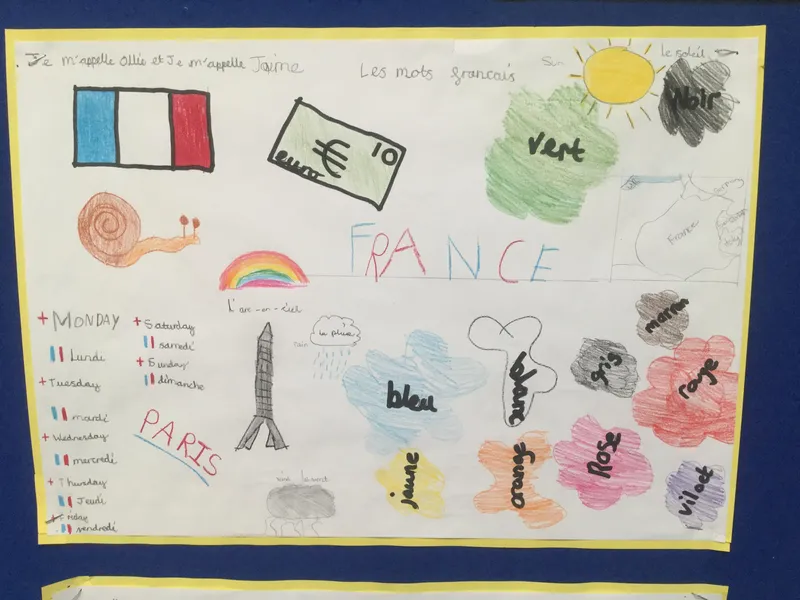
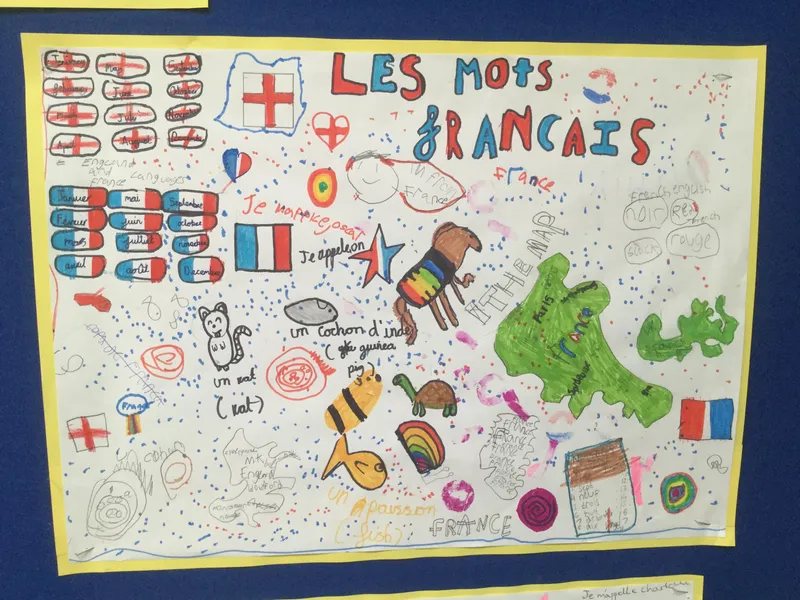
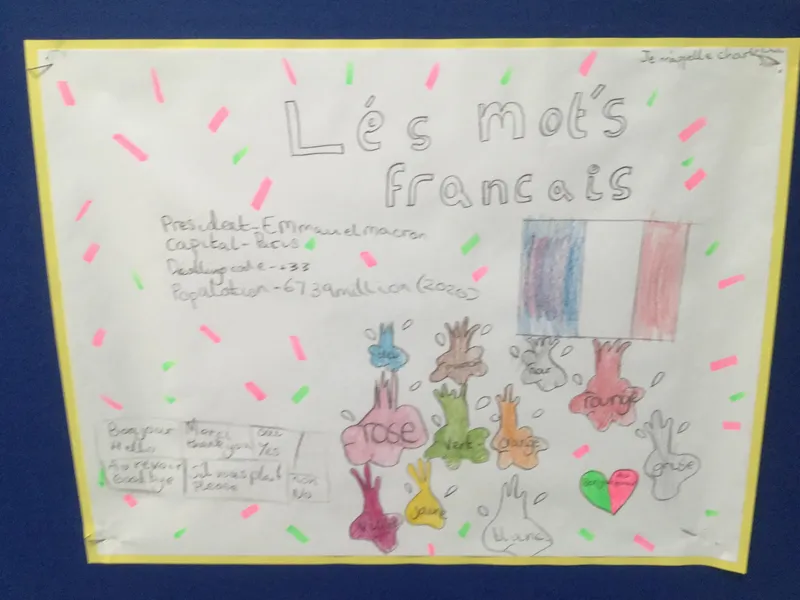
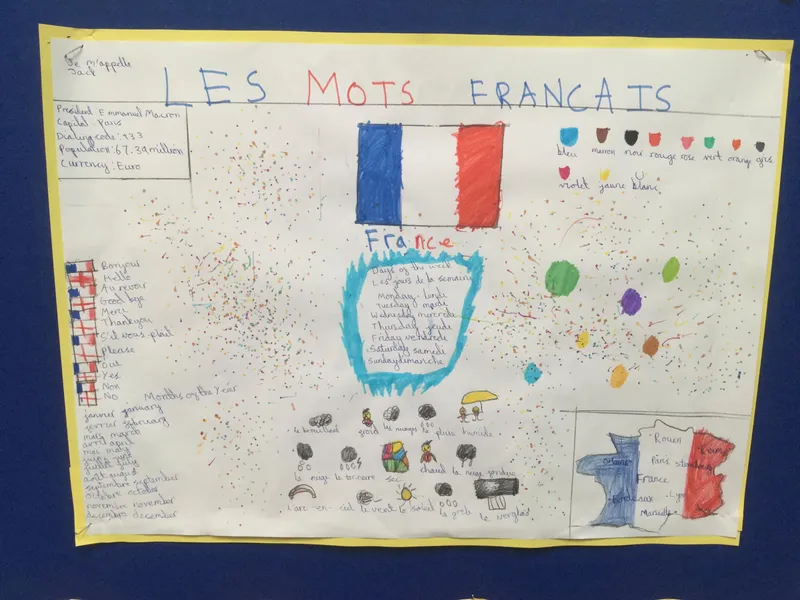
- Pupil voice this year has shown that our pupils enjoy their learning in French, especially when they can practise talking to each other in another language or when they are working collaboratively to create posters. They also enjoy the use of songs and games that make their learning fun.
- Each class in KS2 produces a poster for each unit of work, showcasing and celebrating what they have learnt from the half term.
- Monitoring of the class books has indicated that regular lessons are being taught and every pupil’s work is represented over a unit of learning.
- In 2024/25, 79% of pupils achieved age related expectations or above, with 15% achieving greater depth.
To see our learning in French, please visit the French page on the 'Curriculum Blogs' section.
MFL National Curriculum
| Name | Format | ||
|---|---|---|---|
| Files | |||
| MFL National Curriculum.pdf | |||
MFL Curriculum Overview
| Name | Format | ||
|---|---|---|---|
| Files | |||
| MFL Overview 2025 - 2026.pdf | |||
| MFL Key Content 2025 - 2026.pdf | |||
MFL Skills and Knowledge Progression
| Name | Format | ||
|---|---|---|---|
| Files | |||
| MFL Skills and Knowledge Progression 2025 - 2026.pdf | |||